
By Daniel Brooks — Sonar Shield. Daniel Brooks is an editorial pen name used by Sonar Shield.
Good clues deserve a question, not an instant rule. When something on the water catches your attention, separate what you actually saw from the explanation you attach to it.
What the September 23 report showed
Bassmaster reported that Kaden Buchmann led Norfork's September 23 opening day with 16 pounds, 7 ounces. His approach included moving between areas and looking for signs of undisturbed water. Read the original Day 1 report for the competition details. This is a snapshot of that day, not a claim about the final result.
That report prompted the exercise below. It is Sonar Shield's own editorial tool for recreational and tournament anglers, not a set of instructions attributed to Buchmann. We did not interview him and do not claim he uses or endorses our gear.
Make a two-column observation card
Use the left column for what happened and the right column for the question it raises. Keep the first column specific enough that another angler could understand it without sharing your assumptions.
- Observation: a bite came beside one shaded piece of cover. Question: does the next comparable piece produce a similar response?
- Observation: a baitfish group moved when the wind changed. Question: is the movement repeatable, or did I see a one-time event?
- Observation: several similar-looking targets produced different results. Question: what visible feature, presentation or timing differed?
These are hypothetical examples to help structure your notes. They are not reports of Buchmann's catches or guaranteed bass-fishing patterns.
Choose one comparison
A useful follow-up changes as little as practical. If you are comparing shaded and exposed cover, start by keeping the presentation consistent. If you change the area, lure, retrieve and depth at once, record that uncertainty rather than claiming you isolated the cause.
Make room for negative evidence. An apparently promising clue that fails on the next several comparisons is still information. Write down what would weaken your explanation, not only what would support it. The aim is to leave with a better question, even when the fishing is difficult.
Keep the routine usable on the boat
A short note after an area can be more useful than a long story reconstructed later. Record time, a brief observation, the next comparison and the outcome. Follow safe boat-handling practices and make notes when stopped in an appropriate place.
Before fishing, organize the equipment you need for those comparisons. Check protective accessories, loose cable runs and your storage arrangement. A simple preparation routine gives you fewer equipment details to reconstruct while assessing the fishing itself.
Explore Sonar Shield cable management

H-Strap Trolling Motor Cable Holder
Check the current product listing and confirm compatibility with your installation before choosing a pack.
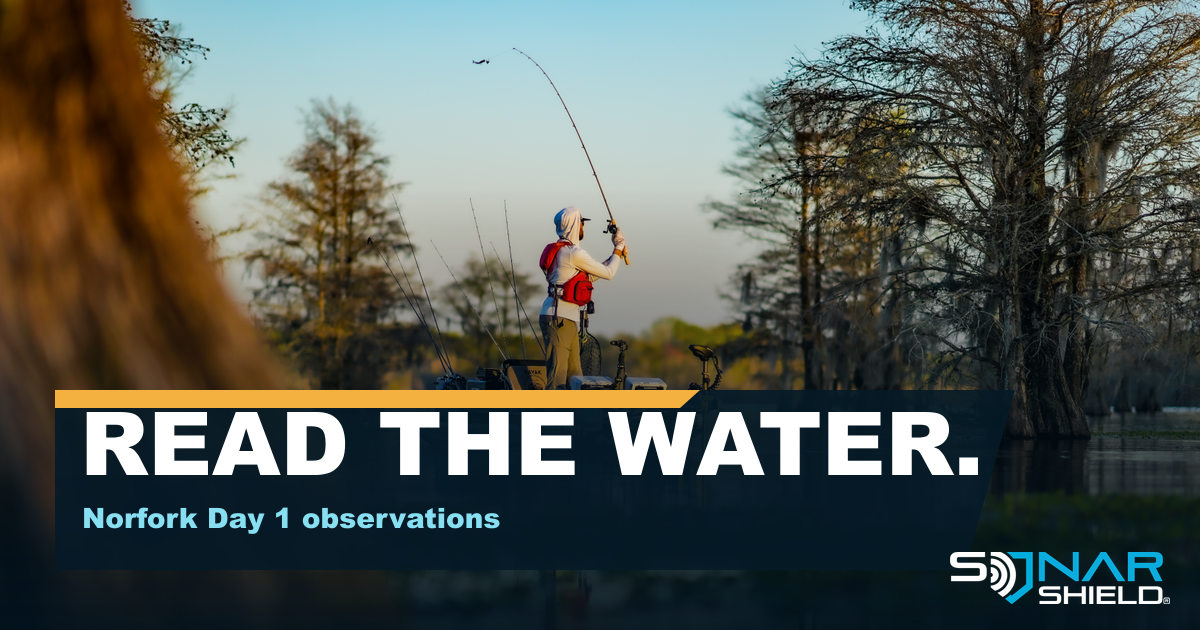
The image is Sonar Shield's own bass-boat library photograph. It does not depict Buchmann or his boat. The related product section is for readers' own equipment and is not an angler endorsement.
Which fishing clue have you learned to question? Share the observation—and what your next comparison taught you.