
Explore Sonar Shield neoprene fishing rod sleeves for spinning and casting rods.
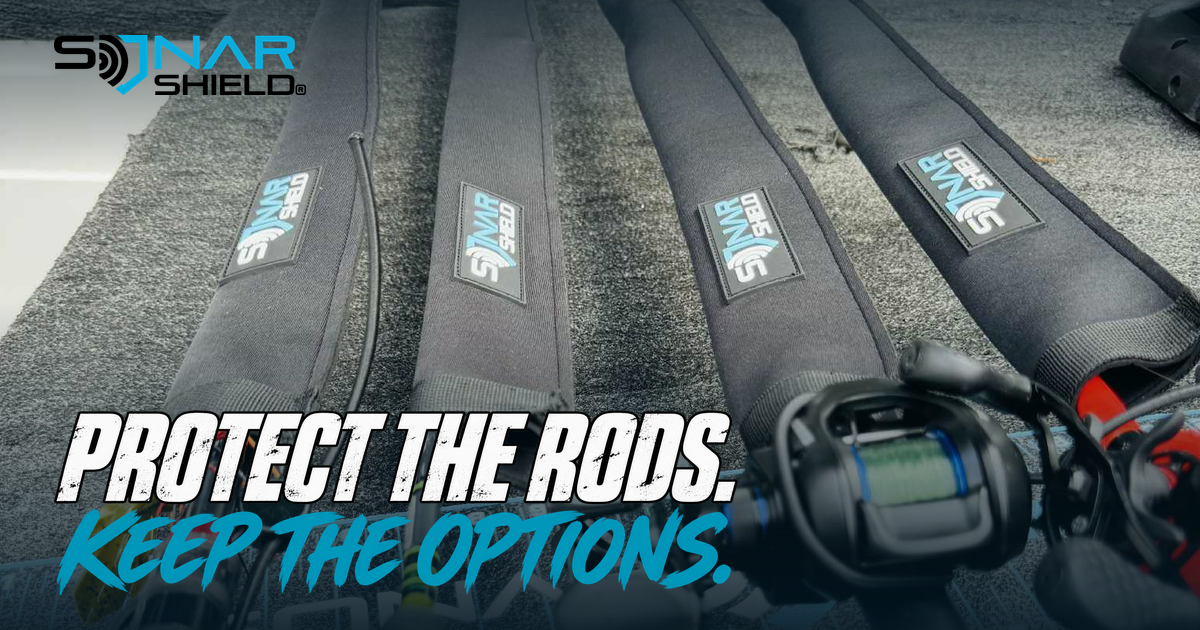
Several rods on the deck can mean several useful options: a different presentation, a different depth, or another question to try. Those choices are worth organizing before the boat goes into storage. The supplied Sonar Shield photograph shows four branded sleeves fitted over rods, with the reels still visible. It illustrates the sleeve's protective role without turning the photograph into a claim about anyone's fishing results.
Start with what the sleeve protects
Sonar Shield's current listing describes hook-resistant neoprene, a reinforced tip and reinforced edging. The sleeve helps protect the blank, guides and tip from scratches, scuffs and everyday contact during storage and transportation. Hook-resistant does not mean a hook cannot penetrate the material. Handle exposed tackle carefully and keep hooks secured using the appropriate arrangement for your gear.
Match the opening to the guide train
A spinning rod and a casting rod do not use the same guide layout. Choose the spinning sleeve for the larger, taller guides typical of spinning rods. Choose the casting version for smaller, low-profile guides. Check the exact rod and the current listing rather than forcing a narrow sleeve opening over a guide.
The listing identifies both versions for most rods from 6 feet 10 inches to 7 feet 6 inches. Spinning is listed at 62 inches long with a 3.5-inch opening; casting is 64 inches long with a 2.5-inch opening. Those dimensions help you check the choice before ordering; they are not a universal fit promise.
Try a simple deck-to-storage sequence
Our suggested routine begins after the fishing is finished. Separate the rods so one line is not crossed around another. Check the blank, tip and guide train as you handle each rod, and follow the product directions when fitting its sleeve. A sleeve should support deliberate handling rather than encourage pulling a tangled bundle apart.
Choose a storage arrangement that leaves the equipment supported and secured for its journey. Sleeves provide a protective layer; the boat's rod-retention or transport arrangement still has its own job. Before the next trip, remove each sleeve carefully, keep it somewhere secure and check the rod before use.
Keep the choices easy to recognize
Organize by the presentations you expect to fish rather than simply adding more rods. Which option do you reach for first, and which is your backup? A repeatable arrangement makes the transition between fishing and storage easier to follow.
Choose the Sonar Shield rod sleeve for your setup. Product specifications and photograph: Sonar Shield, checked November 6, 2026. Original rods, reels, boat setting and physical branding are preserved; the photograph is not presented as a new event or a first-hand field test.
Created with AI assistance using Sonar Shield's topic direction and research from the sources cited in this article.