
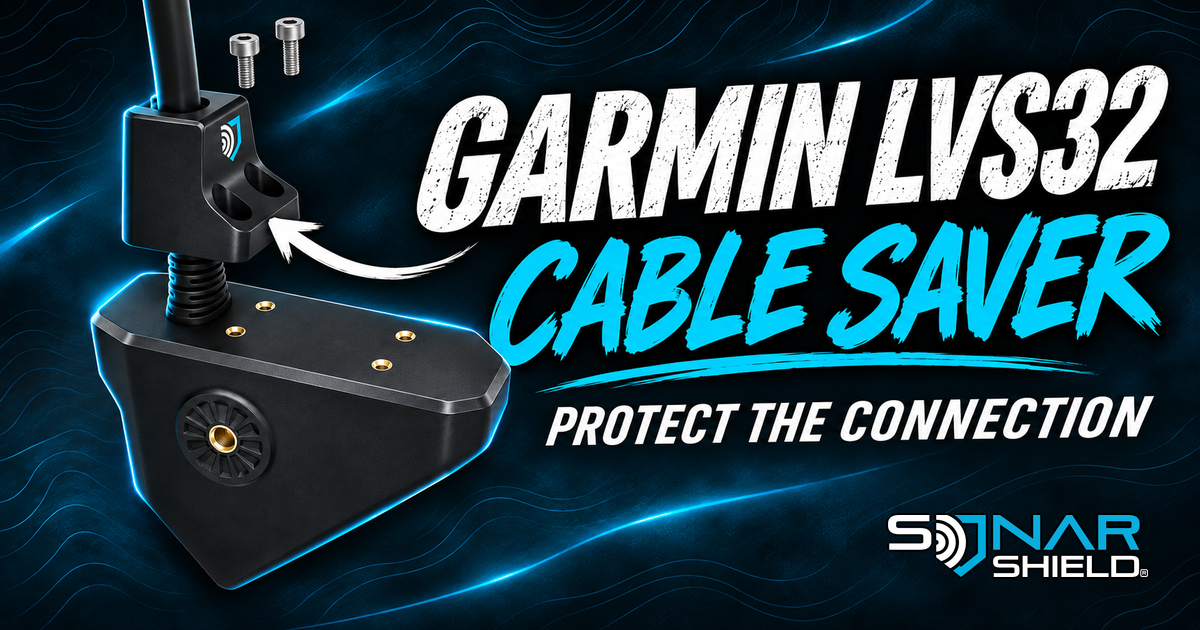
A transducer cable deserves attention along its route and at the point where it enters the sonar. The Sonar Shield Garmin LiveScope LVS32 Cable Saver is a bolt-on guard for that entry area. Its job is focused: add protection around a vulnerable connection, alongside sensible cable routing.
Start with the exact connection
Our product listing describes a guard mounted on top of the LVS32 with two stainless steel screws. The catalog illustration accompanying this guide is an exploded view: the separated screws explain the mounting arrangement; they do not show an incomplete installation on somebody's boat. Check the supplied directions and your exact mount before installation. This LVS32 accessory should not be assumed to fit an LVS34, LVS44 or LVS42HD.
Give the rest of the cable a deliberate look
Start with the boat secured and the equipment in a safe condition for inspection. Follow the cable visually from the transducer toward its support points. Look for places where it rests against an edge, passes close to a moving joint, or has an abrupt bend. A guard around the entry does not make those other contact points disappear. If you notice damage, stop and seek the relevant manufacturer's guidance rather than hiding it under an accessory.
The useful question is whether the intended movement can occur without pulling directly at the entry point. Use the installation's documented procedure to check clearance; keep hands away from pinch points and do not improvise a powered movement test. Do not tighten routing supports simply until everything looks motionless. The setup still needs appropriate movement and clearance.
A simple three-part inspection note
- Entry: note the guard, attachment and cable condition you can actually see.
- Route: identify the closest edge or moving component along the cable's path.
- Change: after any adjustment, revisit that same area using the equipment's instructions.
This is our suggested inspection framework, not a universal installation specification. Torque values, bend limits and mounting instructions belong to the applicable equipment documentation. If the mounting hardware or layout does not match the supplied directions, contact support before proceeding.
Protect the system you rely on
A cable guard and careful routing address different parts of the same protection goal. Neither promises that a cable cannot be damaged. Match the accessory to the real transducer, follow the directions, and make the closest contact point part of your regular gear check.
Source checked November 8, 2026: Sonar Shield LVS32 Cable Saver product details. Original Sonar Shield catalog artwork; no independent testing or manufacturer endorsement is claimed.
Created with AI assistance using Sonar Shield's topic direction and research from the sources cited in this article.