
Emily Reed — Sonar Shield editorial pen name
You can start where you are
You do not need a childhood fishing story to belong on the water. Kylee Short's example offers a useful starting point for women who want to try bass fishing as adults and for anyone helping a friend get started.
Bassmaster's 2026 BassmastHER profile identifies Short as a self-taught angler who began as an adult and emphasizes her work making fishing approachable. The profile lists a Top 10 in the Florida Bass Nation Kayak Series and her participation in education and community events. Those are reported facts from the profile, not results announced today.
Keep the first outing small enough to enjoy
The learning plan below is Sonar Shield's original suggestion. It is not a technique attributed to Short or a claim that we interviewed her. Its purpose is to make a first or returning fishing trip manageable.
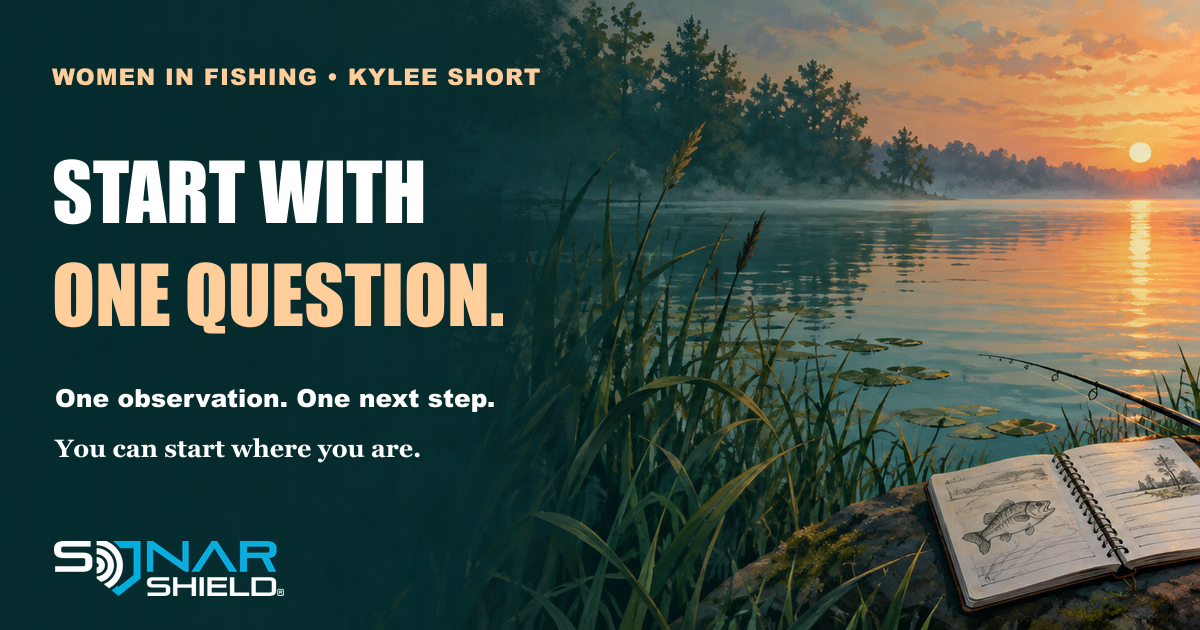
- Pick one question. Decide what you want to learn before you start. Can you cast accurately to a chosen target? Can you tell when your lure reaches bottom? Can you identify the depth shown on your own fish finder? One specific question is easier to revisit than a goal of learning everything.
- Choose one observation. Notice what happens rather than immediately assigning a cause. Write down a visible feature, the depth you observed or the point in a retrieve when a bite happened. A short note can be enough.
- Finish with one next step. Decide what you would like to repeat or ask about on another trip. A useful outing can end with a better question, even when the catch is modest.
If you are helping someone, ask which skill they want to practice. Avoid changing the lure, location, retrieve and equipment settings all at once. Give them time to recognize what one change does, and let them make a decision for themselves.
Make the equipment explanation useful
Explain the control that answers the immediate question. On a fish finder, that might be the depth reading, the selected view or how to return to a familiar screen. Use the manual for the exact model. You do not have to introduce every menu in the first lesson.
A good teaching exchange starts with what the new angler can see. Ask them to describe the screen or cast before offering an interpretation. That makes it easier to distinguish a control they have not learned yet from a fishing question that needs another observation.
Find a community, not a test you must pass
A local club, workshop or trusted fishing partner can give you a place to ask questions. Before attending, check the organizer's current details and ask what equipment is supplied, what you should bring and whether the format welcomes beginners. You do not need to pretend that you know a term you have not heard before.
For a buddy outing, agree on the meeting place, length of the trip and a simple learning goal. Choose access, conditions and equipment appropriate to your experience, and check the local fishing requirements. Practical planning leaves more room to enjoy learning together.
Build a routine you want to repeat
At the end, put the equipment back in a familiar place and record the question you want to revisit. If you use marine electronics, explore Sonar Shield accessories for your own device. Match each cover or visor to the specific equipment and intended use.
Which question would you help a new angler answer first? Share it with someone who wants to get started. This independent feature does not imply that Kylee Short uses or endorses Sonar Shield.
The artwork is an original editorial illustration, not a photograph of Kylee Short or an event. Emily Reed is an editorial pen name used by Sonar Shield, not a separate independent reviewer.
Created with AI assistance using Sonar Shield's topic direction and research from the sources cited in this article.