
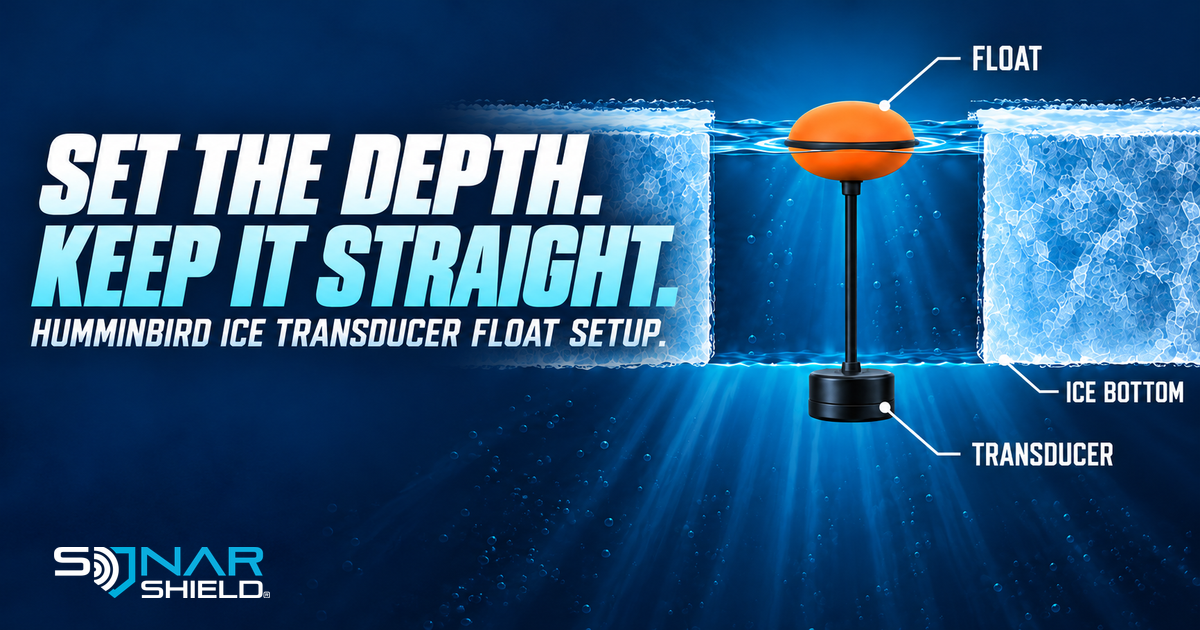
Before changing several sonar controls, give the physical setup a look. A floating ice transducer needs to sit at the intended depth and hang in the intended orientation. Humminbird's ICE Transducer Installation Guide 532506-3_C explains the float arrangement.
The placement described by Humminbird
The guide directs the cable through the float's slit. Adjust the float so the transducer is submerged, with its bottom even with or slightly below the bottom of the ice. Place the cable clamp above the float as a stop and keep the cable taut enough for the transducer to hang straight down. The instructions also keep connectors out of submerged or flooded locations and warn against forcing keyed connections.
A simple setup sequence
First identify your actual transducer and control-head instructions. The conceptual illustration accompanying this article explains position; it is not a model-specific installation drawing or a scale measurement. Use the manufacturer's guide for the actual parts and connections.
Once it is safe to work at the hole, compare the transducer's position with the bottom of the ice. Do not use the snow surface as the reference point. Check that the float and clamp maintain the intended depth and that the transducer hangs vertically rather than being held at an angle against the side.
Separate physical setup from menu experiments
Our suggested learning routine is to check one thing at a time: placement first, then the display's appropriate operating mode, then any deliberate settings experiment. Write down what you change and compare in the same hole before moving on. This makes a change easier to interpret than adjusting depth, sensitivity and several other controls together.
A useful note can be short: date, control-head model, transducer model, approximate water depth, physical position and the single setting changed. It is a record for your own comparison, not a universal prescription for another lake.
Know which question you are answering
If the result is unclear, distinguish between a physical-position question, a connection question and a menu-selection question. Check the relevant manual section rather than assuming every unexpected mark calls for a new sensitivity value. If the system is not operating as described, use the manufacturer's support route for your exact setup.
Sonar equipment does not establish that ice is safe. Follow current local ice-safety guidance and the installation guide's precautions. This article covers transducer setup, not an assessment of travel conditions.
Start with a repeatable baseline
The goal is a physical arrangement you can describe and check before experimenting. With the transducer positioned according to its instructions, make controlled comparisons and keep the useful results. Which part of your ice setup takes the most adjustment: float position, the cable arrangement or the display controls?
Created with AI assistance using Sonar Shield's topic direction and research from the sources cited in this article.