
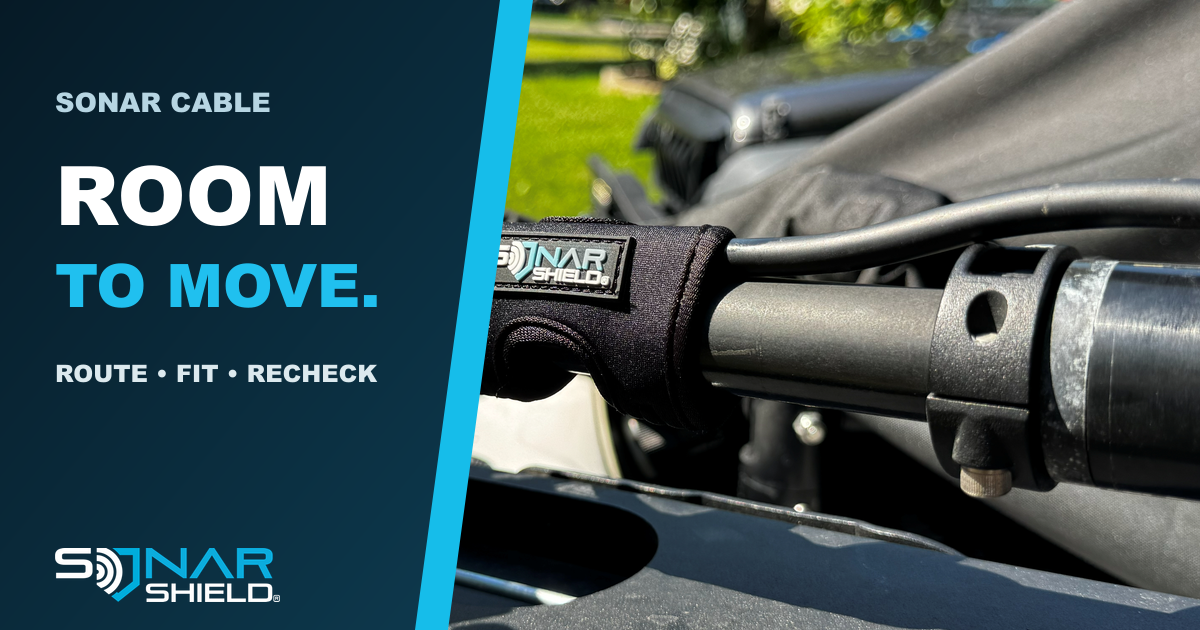
A neat-looking cable is only the start. The routing also needs to work as your trolling motor moves between its intended positions. A holder should organize the installation without becoming the point where a cable is pulled tight.
View the Sonar Shield H-Strap and current availability →
Start with the fit
The Sonar Shield H-Strap is designed to secure a forward-facing sonar cable to a suitable trolling-motor shaft or housing. Its listed limit is a round mounting surface up to 1.7 inches in outside diameter. The H-shaped design separates the section around the mounting surface from the section holding the cable. Check the actual surface rather than choosing by sonar brand alone.
Garmin LiveScope, Lowrance ActiveTarget and Humminbird MEGA Live installations can differ in shaft, mounting hardware and cable path. A familiar logo on the display does not establish that every part of a particular installation will fit. Follow the instructions for the motor, transducer and holder together.
Our three-part movement check
- Trace the route. With the system safely stopped and handled according to its manufacturer's instructions, follow the cable from the transducer toward its connection. Look for a sharp edge, an existing worn spot or a section trapped beneath hardware. Organizing a damaged cable is not a repair.
- Check the holder. Fit it to an appropriate mounting surface and secure its intended closures. Keep the cable supported without crushing it. Do not force a holder onto an unsuitable diameter or improvise extra holes.
- Check the movement. Follow the motor manufacturer's safe procedure to check the required stow, deploy and steering positions. Watch the cable through the movement—not just at either end. Stop if it pulls tight, gets pinched or rubs a moving part. Resolve the route before operating.
This is Sonar Shield's editorial inspection routine, not a replacement for a motor-specific installation manual. There is no universal slack measurement in this guide: the correct route depends on the equipment and its movement.
Look again after the first trip
Reinspect where the holder meets the cable and mounting surface. A new rub mark, loosened closure or shifted route tells you the setup needs attention. Photograph a correctly checked arrangement for your own reference so a change is easier to spot later.
Make the check part of an existing habit: before moving the boat, after adjusting the transducer mount and whenever cable routing changes. The holder is for cable organization; it is not a lifting strap, a tow point or a substitute for the equipment's required mounting hardware.
Explore Sonar Shield cable management

H-Strap Trolling Motor Cable Holder
For suitable round mounting surfaces up to 1.7 inches in outside diameter. Check your installation and the current product instructions. The listing was unavailable when checked September 24, 2026; see the product page for current pack options and availability.
What part of your cable route is easiest to overlook? The turn, the stow position or the run back to the connection? That is a useful place to start your next inspection.
Sources: current H-Strap specifications and Sonar Shield product care guidance. Product details checked September 24, 2026. The photograph shows our real installed H-Straps; hardware and cable routing have not been generated.